Origin-
The term black humor (from the French humour noir) was coined by the surrealisttheoretician André Breton in 1935 to designate a subgenre of comedy andsatire in which laughter arises from cynicism and skepticism, often relying on topics such as death.
Breton coined the term for his book Anthology of Black Humor (Anthologie de l'humour noir), in which he credited Jonathan Swift as the originator of black humor and gallows humor, and included excerpts from 45 other writers. Breton included both examples in which the wit arises from a victim with which the audience empathizes, as is more typical in the tradition of gallows humor, and examples in which the comedy is used to mock the victim. This victim's suffering is trivialized, which leads to sympathizing with the victimizer, as is the case with Sade. Black humor is related to that of the grotesque genre.
Breton identified Swift as the originator of black humor and gallows humor, particularly in his pieces Directions to Servants (1731), A Modest Proposal (1729), A Meditation Upon a Broom-Stick (1710), and a few aphorisms.
The terms black comedy or dark comedy have been later derived as alternatives to Breton's term. In black humor, topics and events that are usually regarded as taboo, specifically those related to death, are treated in an unusually humorous or satirical manner while retaining their seriousness; the intent of black comedy, therefore, is often for the audience to experience both laughter and discomfort, sometimes simultaneously.
Adoption in literary criticism-
Bruce Jay Friedman, in his anthology entitled Black Humor, imported the concept of black comedy to the United States. He labeled many different authors and works with the idea, arguing that they shared the same literary genre. The Friedman label came to prominence in the 1950s and 1960s. Early American writers who employed black humor were Nathanael West and Vladimir Nabokov. In 1965 a mass-market paperback titled Black H umor, was released. It contained work by a myriad of authors, which included J.P. Donleavy, Edward Albee, Joseph Heller, Thomas Pynchon, John Barth, Vladimir Nabokov, Bruce Jay Friedman himself, and Louis-Ferdinand Celine. This was one of the first American anthologies devoted to the conception of black humor as a literary genre; the publication also sparked nationwide interest in black humor. Among the writers labeled as black humorists by journalists and literary critics are Roald Dahl, Thomas Pynchon Kurt Vonnegut. Warren Zevon, John Barth, Joseph Heller, and Philip Roth. The motive for applying the label black humorist to all the writers cited above is that they have written novels, poems, stories, plays, and songs in which profound or horrific events were portrayed in a comic manner.
The purpose of black comedy is to make light of serious and often taboo subject matter; some comedians use it as a tool for exploring vulgar issues, thus provoking discomfort and serious thought as well as amusement in their audience. Popular themes of the genre include murder, suicide, depression, abuse, mutilation, war, religion, barbarism, drug abuse, terminal illness, domestic violence, sexual violence, pedophilia, insanity, nightmare, disease, racism,, disability(both physical and mental), chauvinism, terrorism, genocide, corruption, torture, and crime.
Comedians, like Lenny Bruce, that since the late 1950s have been labeled for using "sick comedy" by mainstream journalists, have also been labeled with "black comedy".
By contrast, blue comedy focuses more on crude topics such as nudity, sex, and bodily fluids. Although the two are interrelated, black comedy is different from straightforward obscenity in that it is more subtle and does not necessarily have the explicit intention of offending people. In obscene humor, much of the humorous element comes from shock and revulsion, while black comedy might include an element of irony, or even fatalism. For example, the archetypal black-comedy self-mutilation appears in the English novel Tristram Shandy. Tristram, five years old at the time, starts to urinate out of an open window for lack of a chamber pot. The sash falls and circumcises him; his family reacts with both chaotic action and philosophic digression.
Motion Pictures-
Black comedy is commonly used in dramatic or satirical films, retaining its serious tone and working as a tool of many films, television shows, and video games.Stanley Kubrick's 1964 film Dr. Strangelove presents one of the best-known mainstream examples of black comedy. The subject of the film is nuclear warfareand the possible annihilation of life on Earth. Normally, dramas about nuclear war treat the subject with gravity and seriousness, creating suspense over the efforts to avoid a nuclear war, but Dr. Strangelove instead plays the subject for laughs. For example, in the film the fail-safe procedures designed to prevent a nuclear war are precisely the systems that ensure that it will happen. Another example is the closing scene of Monty Python's Life of Brian where Brian and others sentenced to death bycrucifixion sing and whistle a cheerful tune centering on death not being such a bad thing: "Always Look on the Bright Side of Life".
Modern examples of black comedy in film include: Bad Santa, a 2003 Christmas-themed film about a drunken, foul-mouthed professional thief who doubles as a department store Santa; Heathers, a 1988 high school movie about a couple of teens who decide to kill the popular kids at their school and make it look like suicide; Pulp Fiction, a 1994 crime noir film of three intertwining gangster stories; Observe and Report, a 2009 film about a violent, bigoted, delusional mall cop with bipolar disorder and sociopathic and fascist tendencies; Horrible Bosses, a 2011 film about three men who resolve to murder their respective overbearing bosses; Cheap Thrills, a 2013 film about how far two men would go for monetary gain; and Filth, a 2013 film about a bigoted, corrupt, Machiavellian policeman and his slow descent into insanity. All of these films, though mostly critically and commercially successful, were met with criticism for their politically incorrect subject matter.
Over time, black comedy films have taken on a larger scope. For example, while the aforementioned Dr. Strangelove deals with the events leading up to the annihilation of humanity, the 2013 disaster film This Is the End takes a darkly humorous approach to events after the annihilation of humanity. The film follows a group of actors (all playing satirical versions of themselves) as they encounter demons, monsters and psychotic cannibals after the Biblical Rapture. The film was both a critical and commercial success.
While many black comedy films like This Is the End are high-concept and grandiose in scope, black comedies can also be character-driven, as evidenced by Alejandro González Iñárritu's 2014 film Birdman or (The Unexpected Virtue of Ignorance), which tells the story of an actor, played by Michael Keaton, who is living under the shadow of a former superhero role and attempts to gain back his reputation as a serious actor. The film satirizes the egotistical nature of actors, the typecasting nature of Hollywood, and the lengths to which actors will go to bring realism to their performances. Birdman was critically acclaimed and won the Academy Award for Best Picture.
Shock value as humor-
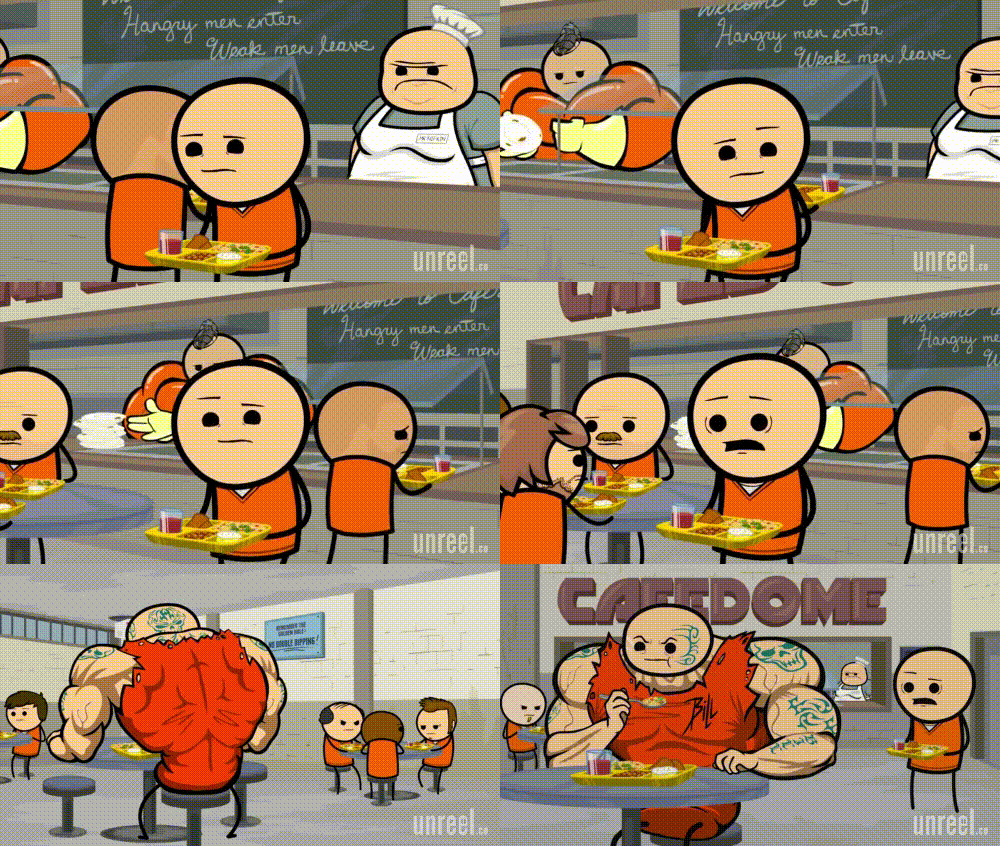
The term off-color humor (also known as dirty jokes) is an Americanism used to describe jokes, prose, poems, black comedy, blue comedy and skits that deal with topics considered to be in poor taste or overly vulgar by the prevailing moralityof a culture. Most commonly labeled as "off-color" are acts concerned with a particular ethnic group or gender. Other off-color topics include violence, particularly domestic abuse; excessive swearing or profanity; "toilet humor"; national superiorityor inferiority; "dead baby" jokes; and other topics generally considered impolite or indecent. Generally, the intent of off-color humor is to induce laughter by evoking a feeling of shock and surprise in the comedian's audience. In this way, off-color humor is related to other forms of postmodern humor, such as the anti-joke.
In the 1990s and modern era, comedians such as Dave Chappelle use shocking content to draw attention to their criticism of social issues, especially censorship and the socioeconomic divide. The highly-praised television show South Park also popularized the use of offensive humor, for which the show has become infamous. The Aristocrats is perhaps the most famous dirty joke in the US due to its high shock value and is certainly one of the best-known and most oft-repeated among comedians themselves.

Shock Advertising-
Shock advertising or Shockvertising is a type of advertising generally regarded as one that “deliberately, rather than inadvertently, startles and offends its audience by violating norms for social values and personal ideals.” It is the employment in advertising or public relations of "graphic imagery and blunt slogans to highlight" a public policy issue, goods, or services. Shock advertising is designed principally to break through the advertising “clutter” to capture attention and create buzz, and also to attract an audience to a certain brand or bring awareness to a certain public service issue, health issue, or cause (e.g., urging drivers to use their seatbelts, promoting STD prevention, bringing awareness of racism and other injustices, or discouraging smoking among teens).
The Benetton Group has come under particular scrutiny for the use of shock advertisements in its campaigns, leading to public outrage and consumer complaints. However, several of Benetton’s advertisements have also been the subject of much praise for heightening awareness of significant social issues and for “taking a stand” against infringements on human rights, civil liberties, and environmental rights. Benetton’s advertisements have featured images of portions of men’s and women’s bodies with tattoos that say “HIV Positive”, a Black woman breastfeeding a White infant (which could be celebrated as a championing image of racial diversity or raising awareness of racial issues yet was also denounced for its historical connotations when Black women, during slavery, were often required to become caretakers for White children), a priest and a nun leaning to kiss each other, as well as a group of real death row inmates (alluding to issues concerning capital punishment). Other shocking advertisements released by Benetton include an image of a duck covered in oil (addressing issues of oil spillage and the cleanliness of oceans), a man dying of AIDS, a soldier holding a human bone, as well as a newborn infant still attached to its umbilical cord, which "was intended as an anthem to life, but was one of the most censured visuals in the history of Benetton ads." Oliviero Toscani, a photographer for Benetton who contributed to many of its shocking advertisements, said, regarding the advertisement he created of a man dying from AIDS, that he wanted "to use the forum of poster advertising to make people aware of this [AIDS] tragedy at a time when no-one dared to show AIDS patients."
In Music-
Shock rock is a wide umbrella term for artists who combine rock music with elements of theatrical shock value in live performances.
Screamin' Jay Hawkins was arguably the first shock rocker. After the success of his 1957 hit "I Put a Spell on You", Hawkins began to perform a recurring stunt at many of his live shows: he would emerge from a coffin, sing into a skull-shaped microphone and set off smoke bombs.
Marilyn Manson is perhaps the most notable act in the shock rock scene. Known for his controversial stage persona, Manson and his band dress in outlandish makeup and costumes, and have engaged in intentionally shocking behavior both onstage and off. In the past, their lyrics often received criticism for their anti-religious sentiment and references to sex, violence and drugs. Manson's live shows are known for their uniquely theatrical stage presence, which has included Manson burning the American flag, ripping and burning the Bible and tossing it into the crowd, self-mutilating himself on stage, being pulled onto stage in a Roman chariot being pulled by naked women, wearing outrageous costumes and so on.
Other notable acts include Alice Cooper, Rammstein, Iggy Pop, W.A.S.P, GWAR, Twisted Sister, GG Allin, Christian Deathand the Misfits.
Shock value is also big in Hip hop music, and sometimes under the genre of horrorcore. One notable artist is Eminem, known as possibly one of the most controversial rappers of all time. With lyrics using the word "faggot" and songs about murdering his wife, rape, and the use of drugs.
Shock value is a common way to show people graphically how dangerous a situation is, by depicting the death of a minor character, or the serious injury or near death of a character. A frequently referenced example is the deaths of redshirts inStar Trek. Near misses on major characters are commonly used, such as in Star Wars, The Lord of the Rings: The Fellowship of the Ring, etc.
This can also involve the occurrence or performance of disturbing or horrifying phenomena or actions to draw the attention of viewers, or to force them to consider the events depicted at a personal level. Examples would include a scene of a military hospital with patients with horrible or disgusting wounds, a shot of a battlefield covered in corpses, or the depiction ofemotional abuse.